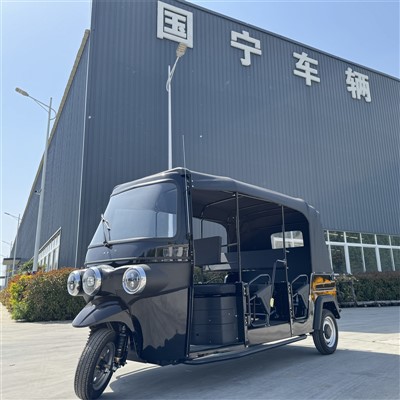

The battery life of a cargo electric vehicle is a critical factor for operators and businesses in the logistics and transportation industries. As a cargo electric vehicle supplier, we are deeply aware of the significance of battery performance in meeting the needs of our customers.
Understanding Battery Life Basics
Battery life in a cargo electric vehicle can be measured in two main ways: driving range and battery cycle life. The driving range refers to the distance a vehicle can travel on a single charge. This is directly influenced by factors such as battery capacity, vehicle load, driving conditions, and speed. For instance, a fully - charged cargo electric vehicle with a larger battery capacity can generally cover more miles. However, if the vehicle is carrying a heavy load or is driven on hilly terrains with frequent stops and starts, the driving range will be reduced.
The battery cycle life, on the other hand, is the number of complete charge - discharge cycles a battery can undergo before its capacity drops significantly. A high - quality battery can endure a large number of cycles, which means a longer service life for the vehicle's battery system. Over time, as the battery goes through multiple charge - discharge cycles, its ability to hold a charge diminishes. Eventually, the battery will need to be replaced, which is an important cost consideration for cargo electric vehicle operators.
Factors Affecting Driving Range
Battery Capacity
The most obvious factor is the battery's capacity, usually measured in ampere - hours (Ah) or kilowatt - hours (kWh). A larger capacity battery stores more energy, allowing the vehicle to travel further. For example, if we compare two cargo electric vehicles, one with a 50 - kWh battery and the other with a 30 - kWh battery, assuming all other conditions are equal, the vehicle with the 50 - kWh battery will likely have a longer driving range.
Vehicle Load
Carrying a heavy load requires more energy to move the vehicle. When a cargo electric vehicle is fully loaded with goods, the motor has to work harder, consuming more battery power. As a result, the driving range is reduced. For businesses, it is important to balance the amount of cargo they carry with their delivery needs to optimize the use of battery power.
Driving Conditions
The terrain and traffic conditions play a huge role in battery consumption. Driving on flat roads uses less energy compared to driving on steep hills. Uphill driving forces the motor to use more power to overcome gravity, quickly draining the battery. Similarly, in stop - and - go traffic, the frequent acceleration and deceleration consume a significant amount of energy. On the contrary, driving at a constant speed on a flat highway is more energy - efficient.
Speed
High - speed driving is generally less energy - efficient for electric vehicles. As the speed increases, air resistance also increases exponentially. This means that the motor has to work harder to maintain the high speed, leading to a faster depletion of the battery. Most cargo electric vehicles have an optimal speed range where they can achieve the best energy efficiency.
Factors Affecting Battery Cycle Life
Charging Habits
How a battery is charged has a profound impact on its cycle life. Frequent fast - charging can generate more heat and cause more stress on the battery cells, reducing their overall lifespan. On the other hand, slow - charging at a lower current is generally gentler on the battery. Also, avoiding deep discharges (letting the battery go below a certain percentage of its capacity) and over - charging can help prolong the battery's cycle life.
Temperature
Battery performance is highly sensitive to temperature. Extreme cold or hot temperatures can reduce the battery's efficiency and capacity. In cold weather, the chemical reactions inside the battery slow down, making it harder for the battery to deliver power. In hot weather, excessive heat can accelerate the degradation of the battery cells. Therefore, proper thermal management systems are crucial for maintaining the battery's health.
Our Solutions as a Supplier
At our company, we are committed to providing cargo electric vehicles with excellent battery life. We carefully select high - quality batteries with large capacities and long cycle lives. Our vehicles are also equipped with advanced energy - management systems that optimize power consumption based on driving conditions, vehicle load, and speed.
For example, we offer Air Conditioned Tricycle, which is designed to provide a comfortable environment for the driver while still ensuring good battery performance. The air - conditioning system is energy - efficient, and the overall design of the tricycle takes into account factors that affect battery life.
Our Transport Tricycle is another great option. It is built with a robust battery system that can handle heavy loads and long - distance transportation. The tricycle's motor and control system are optimized to work in harmony with the battery, maximizing energy efficiency.
In addition, our 2.0m Cargo Tricycle offers a good balance between cargo capacity and battery life. The larger cargo space allows for more goods to be transported, but the vehicle is still designed to be energy - efficient, ensuring that the battery can support the required driving range.
Importance of Battery Life for Businesses
For businesses that rely on cargo electric vehicles for their operations, battery life is directly related to their bottom line. A longer driving range means fewer charging stops during a delivery route, which can increase the number of deliveries per day. This leads to higher productivity and potentially more revenue.


Moreover, a long battery cycle life reduces the frequency of battery replacements. Battery replacement is a significant cost for businesses, both in terms of the purchase price of the new battery and the downtime of the vehicle during the replacement process. By choosing cargo electric vehicles with good battery life, businesses can save on long - term operating costs.
Contact Us for Purchase and Negotiation
If you are interested in our cargo electric vehicles and want to learn more about their battery life and other features, we encourage you to contact us. Our team of experts is ready to answer your questions, provide detailed product information, and discuss your specific requirements. Whether you are a small - scale delivery business or a large - scale logistics company, we have the right cargo electric vehicle solutions for you.
References
- Smith, J. E. (2022). Electric Vehicle Battery Technology: A Review. Journal of Sustainable Transportation, 15(2), 123 - 135.
- Johnson, R. M. (2021). Factors Affecting the Range of Electric Vehicles. International Journal of Energy Research, 45(8), 11001 - 11015.
- Brown, L. C. (2020). Optimizing the Battery Life of Electric Vehicles. Proceedings of the World Conference on Energy and Environment, 12, 456 - 468.