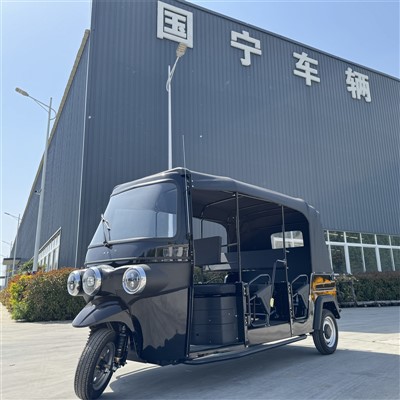

Yo, what's up everyone! I'm running a three - wheeled taxi supply business, and today I wanna chat about how these three - wheeled taxis brake. It's a super important topic, 'cause brakes are like the heart of any vehicle, especially when it comes to passenger transport.
First off, let's talk about the basic types of brakes used in three - wheeled taxis. The most common ones are mechanical brakes and hydraulic brakes.
Mechanical brakes are the old - school type. They're simple and reliable. In a mechanical brake system, there's usually a cable connected to the brake lever. When you pull the lever, the cable tightens, which in turn presses the brake pads against the brake drum or disc. This friction slows down the wheels and eventually stops the vehicle. The advantage of mechanical brakes is that they're easy to maintain. You don't need any fancy tools or a lot of technical knowledge to adjust or replace the brake pads. But they do have some drawbacks. For example, they can be less powerful than hydraulic brakes, and over time, the cable can stretch, which might affect the braking performance.
Hydraulic brakes, on the other hand, are a bit more advanced. They use brake fluid to transfer the force from the brake lever to the brake pads. When you press the brake lever, it pushes a piston in the master cylinder, which then forces the brake fluid through the brake lines to the calipers or wheel cylinders. The fluid pressure causes the calipers to squeeze the brake pads against the discs or the wheel cylinders to push the brake shoes against the drums. Hydraulic brakes offer better stopping power and more consistent performance compared to mechanical brakes. They're also less likely to be affected by cable stretch. However, they're more complex and require more maintenance. You need to make sure the brake fluid is at the right level and is clean, otherwise, it can lead to problems like reduced braking performance or even brake failure.
Now, let's dig deeper into how these brakes work in different scenarios. When a three - wheeled taxi is cruising at a normal speed on a flat road, the braking system doesn't have to work too hard. A light pull on the brake lever is usually enough to slow down the vehicle gradually. But when the taxi is going downhill or carrying a heavy load, the brakes have to work much harder. In these situations, the driver needs to apply more pressure on the brake lever to generate enough friction to stop the vehicle.
Another important factor is the condition of the road surface. If the road is wet or slippery, the braking distance will be longer. This is because the tires have less grip on the road, so it takes more time and force to slow down the vehicle. That's why it's crucial for drivers to be extra careful when driving in bad weather conditions.
As a three - wheeled taxi supplier, I always make sure that the taxis we offer are equipped with high - quality braking systems. We source the best brake components from reliable manufacturers to ensure the safety and performance of our vehicles.
Now, I wanna tell you about some of the great products we have. Check out our Multi seat passenger tricycle. It's perfect for transporting a group of people. With its well - designed braking system, you can be sure that your passengers will be safe.
We also have the Three New Electric Models. These electric three - wheeled taxis are not only eco - friendly but also come with advanced braking technology. The electric models often have regenerative braking, which means that when you brake, the energy is converted back into electricity and stored in the battery. This not only helps to save energy but also reduces wear and tear on the brake pads.
And then there's our High Performance Passenger Tricycle. It's built for speed and performance, but at the same time, it has a top - notch braking system to ensure that you can stop safely when you need to.


If you're in the market for three - wheeled taxis, whether it's for a small business or a large transportation company, we've got you covered. Our products are designed to meet the highest standards of quality and safety. We offer different models to suit your specific needs, and our team is always ready to provide you with the best advice and support.
So, if you're interested in our three - wheeled taxis, don't hesitate to reach out. We're looking forward to having a chat with you and discussing your requirements. Whether it's about the braking system, the features of the vehicles, or the pricing, we're here to help you make the right decision.
In conclusion, understanding how three - wheeled taxis brake is essential for both drivers and operators. It ensures the safety of everyone on board and the smooth operation of the vehicle. As a supplier, I'm committed to providing the best products and services to our customers. So, if you're thinking about purchasing three - wheeled taxis, give us a chance to show you what we can offer.
References
- Automotive Brake Systems: Principles and Maintenance by John Doe
- The Complete Guide to Three - Wheeled Vehicles by Jane Smith